
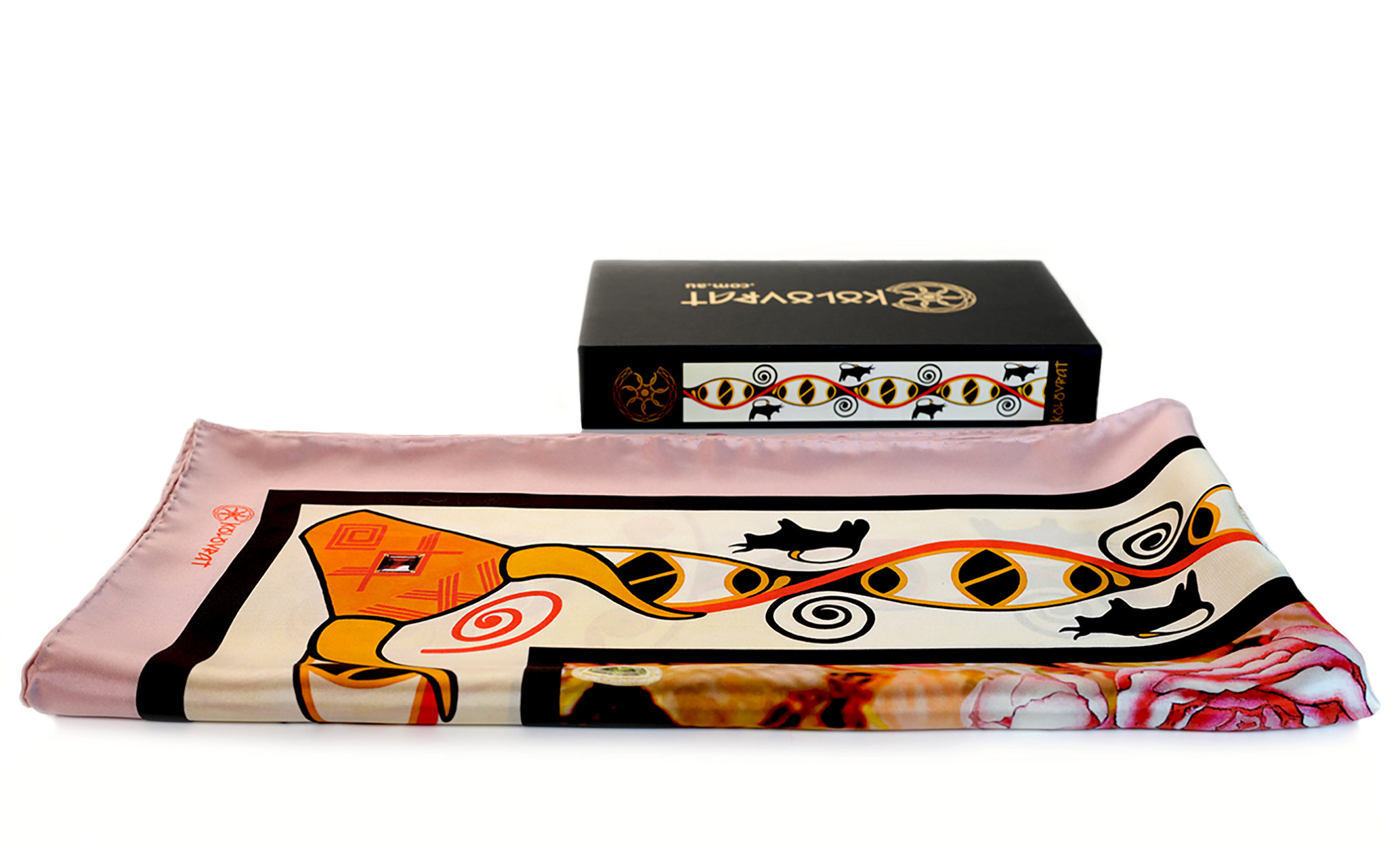
The Beginning: Decoding the Silk Scarf Design
Part 2.
Hello my dear readers,
Welcome to the Part 2 of PSICHORA blog, which is dedicated to revealing the truth about another image I created for the The Beginning silk scarf design. Now we come to the question to which I promised to give you detailed explanations in a previously published blog’s chapter: What is the purpose of the wave-like pattern around the perimeter of the silk scarf and what are the events, objects and subjects which contributed to this scarf design selection.
To begin this uncovering journey, I would like to ask you to take another look at the design section of this silk scarf where I have inserted a wavy pattern which contains diverse bull images ( the subject of a bull we have already discussed earlier in a Part 1 for this blog-post).
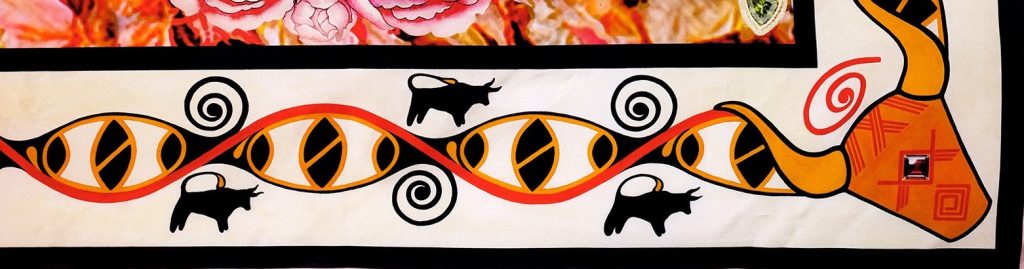
Below I present to you a few images that I consider to be key elements necessary to understand what I am going to talk about a little later.
My first personal impression, which arose when I observed numerous wave-like patterns drawn, painted on or embossed onto Trypillian ceramics, was immediately associated with a highly stylised yet still recognised image of human DNA – a twisted ladder molecule that carries genetic information for the development and functioning of the body and which lives in almost every cell of our bodies.
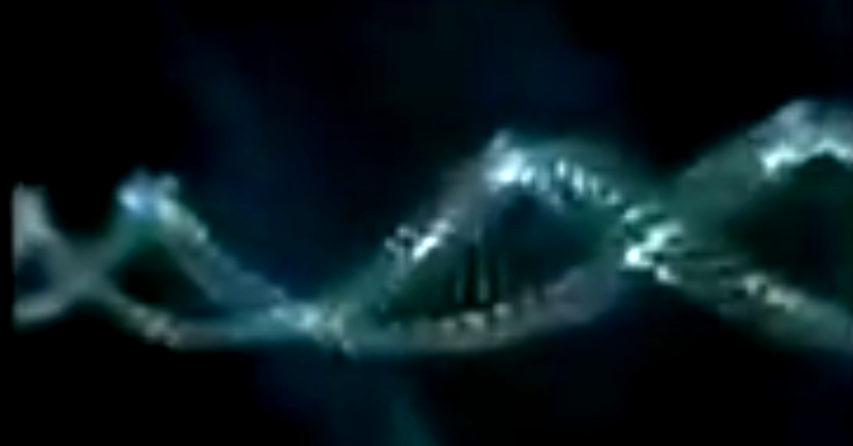
The similarity of the DNA image seems to me unmistakable, and I am sure that my readers will see this with their own eyes by observing the examples of Trypillian patterns that I give in this chapter – regardless of their visual precision, they carry the same consistency in detail and symbols.
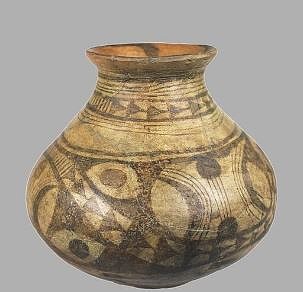
Trypillian pot, Ukraine 4800–2750 BC
Then I present to you a few images that I consider to be key elements necessary to understand what are those connections in between them and my scarf design and why I have chosen that wavy pattern design to become a silk scarf pattern in general.
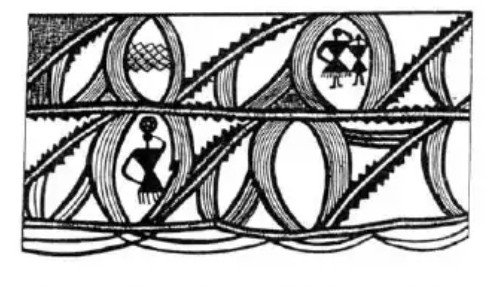
Above: Trypillian hand pained clay pot wavy pattern including human’s female figures.
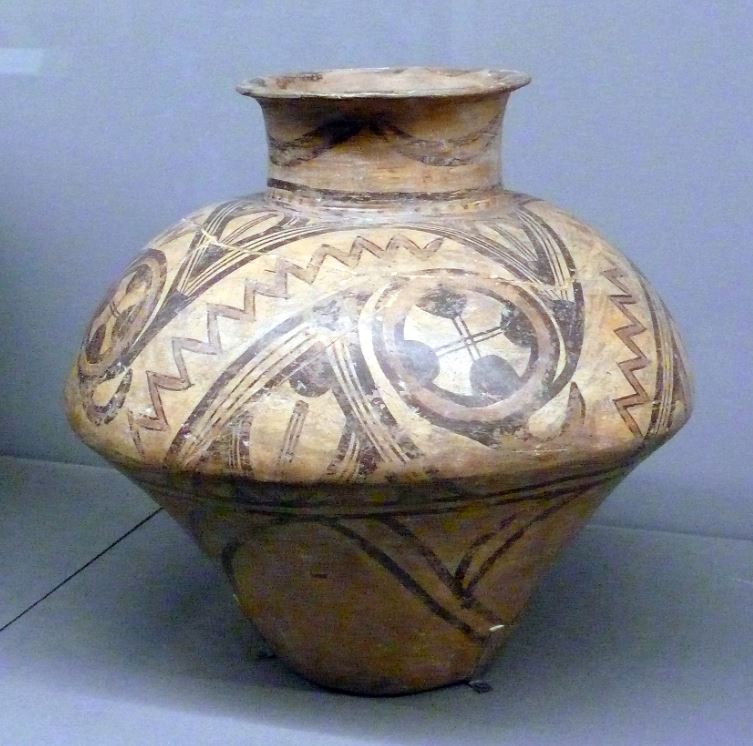
Trypillia-Cucuteni Pottery, Romania, 3700-3500 BC
It seems that the Trypillian potters (who were usually women) were obsessed with images of dividing cells and the strands of DNA waving around each other. It also seems that they not only decorated the pots with procreative energies of these symbolic images, but were also determined to preserve this information, to pass it on to future generations as very valuable messages. To put it into perspective, Trypillian potters created this visual library of scientific images of molecular biology between 6,000 and 4,000 BCE. It makes you rethink a lot, doesn’t it?
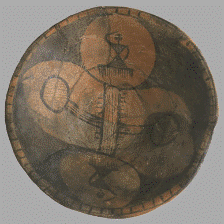
The above image feels so much appealing in telling its almost naked truth: when a man and a woman create and intimate bridge between them, the process of procreation begins – the gem-cell gets fertilised and starts to multiply. The similarity of the DNA image circling around the dividing gem-cell seems to me unmistakable, and I am sure that my consistent readers will agree with me on this – the examples of Trypillian patterns that I give in Pats 1-2 of this post-blog carry consistency in similar details.
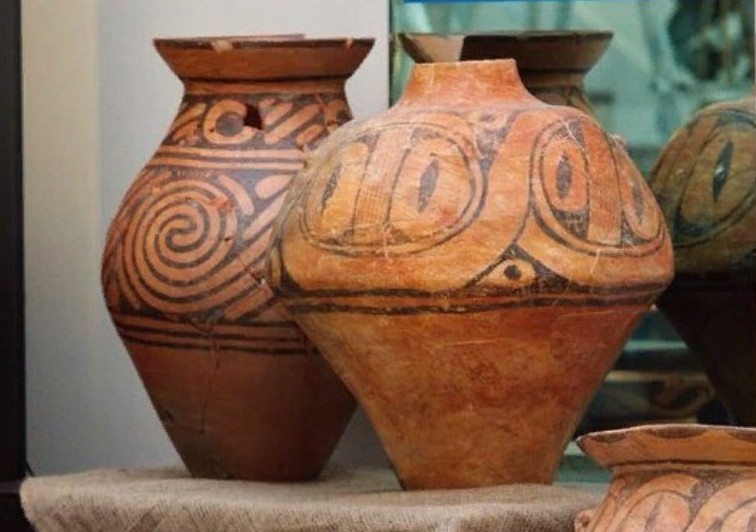
Trypillian pot, Ukraine 4800–2750 BC
Seeing such DNA symbols these days would certainly not surprise any of us, but I would gently remind my reader that we are now looking at archaeological sites dating back to 5500 BC or perhaps even earlier in history. Excavations of monuments of the Trypillian-Cucuteni culture continue. continues to reveal more, and we must be prepared for even greater surprises in both artifacts and their dating: our technology is constantly evolving, which in turn has every opportunity to correct existing dates to a much older historical period or present us with much older ones even if in same Trypillia- Cucuteni civilisation.
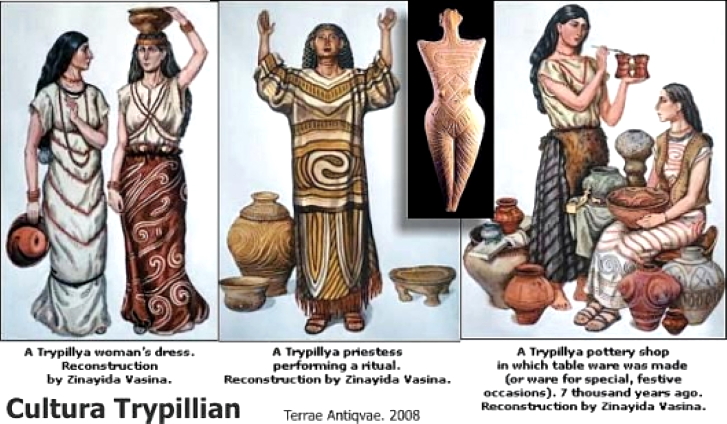
It is really astonishing to me that Trypillian female-potters used DNA and germ cell symbols as decorative elements on ceramics (and other household items). Honestly, it is difficult for me, even with my vivid imagination, to imagine us today so devoted to these very specific images to the level when we surround ourselves and families by them depicted on tea and coffee cups, dished or tea and coffee pots. I just imagined a coffee meeting seeing my friend in a dress and wrapped in a silk scarf sitting around the table almost covered in such images… You see the point? Just how unwavering a faith in the power and efficacy of these images did their life circumstances require for them to go so far as to simply wrap themselves with such images? It remains a mystery to this day…
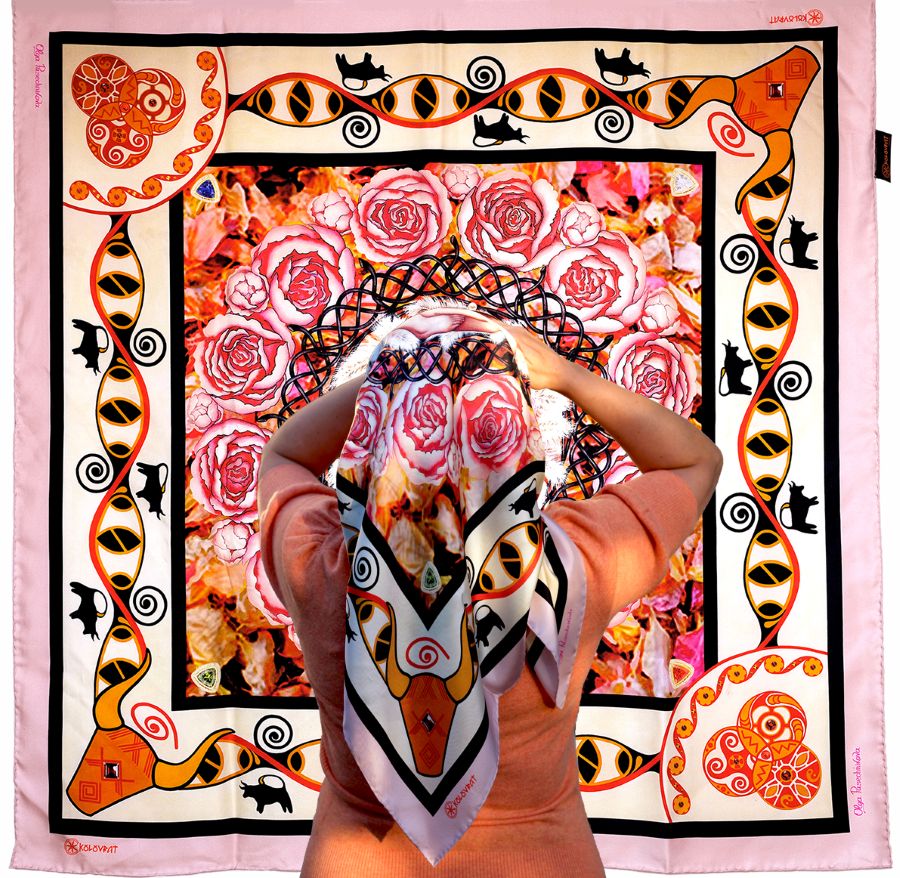
For me, a person of the first half of 21st century AD, with all the knowledge about scientific discoveries of recent years, I personally see their intentions as a wise and profound way to involve procreating vibrations via painted or woven image that will inevitably emanate life-affirming energies onto the owners or pots’ content. They probably used their pots as accessible visual aids about the laws of genetics as well – the knowledge they might have had to preserve and to pass to next generations. But, again, these artefacts came from times that we were taught to consider as primitive and slowly climbing the ladder of evolutionary development… Honestly speaking, I find it difficult to perceive those ‘scholarly sibyls’ in pottery – women who knew this much about cell division and DNA structure – as ‘primitive’ of a ‘hardly developed civilization’.
To be continued in the Part 3.
With love 💕
Leave a Reply